The Right to Protest: Balancing Public Order with Constitutional Expression in India

Right to protest
—BY Garima Bhatia (garimabhatia3453@gmail.com)
Abstract
The Right to Protest is an important pillar of a democratic society. It allows citizens to freely express their opinions, grievances and demands before the government. This right plays a significant role in promoting public participation and holding the government accountable. The right can be exercised only through peaceful means and enables citizens to influence public policies, protect their rights and bring social and legal reforms. This research paper examines the constitutional framework governing the Right to Protest in India and analyses the need to balance this fundamental right with the maintenance of public order in society. Although the Indian Constitution does not expressly mention the Right to Protest, it is derived from Articles 19(1)(a), 19(1)(b) and 19(1)(c), which guarantee freedom of speech and expression, peaceful assembly and association. The paper further highlights that this right is not absolute and is subject to reasonable restrictions imposed by the State under Articles 19(2), 19(3) and 19(4). Additionally, it analyses the development of this right through various landmark judgements alongside recent protests. The primary objective of this research paper is to examine the balance between individual rights and freedoms and the State’s responsibility to maintain public order. It concludes that the Right to Protest is a fundamental right of citizens, indispensable to Indian democracy, and must be exercised peacefully. While the right is not absolute, the State can impose reasonable restrictions in the interest of public order, national security and morality.
Introduction of Right to Protest
The Right to Protest is an important feature of a democratic society. A democratic society allows its citizens to freely express their ideas, thoughts, opinions and feelings without any unreasonable interference or fear of suppression. This freedom of expression is not limited to speech or writing but it allows the people to collectively express disagreement through peaceful means. One of the simplest and most peaceful methods is protest. It allows the individuals to collectively come together and express their opinions and ideas on issues which affect them. Protest may have various forms such as demonstrations, strikes, marches, rallies, collective campaigns etc. All of them draw public and government attention to specific concerns. Through protest citizens come together to voice their concern oppose unjust policies and issues that directly affect their lives. Thus, protest serves as a crucial democratic tool that strengthens
the constitutional expression and public participation.
India is also a democratic country which allows its citizens to freely express their opinions and concerns and also has the right to participate in the public affairs. The Indian Constitution guarantees the Right to Protest as a fundamental right for its citizens. Although the Indian Constitution does not expressly mention the right to protest this right is derived from the
fundamental right under Article 19 (1)(a) which guarantees freedom of speech and expression, Article 19(1)(b) guarantees the right to assemble peacefully and without arms and Article 19 (1)(c) provides the right to form associations or unions.
Although the Right to Protest is a fundamental right, it is not absolute, its excessive exercise may lead to serious consequences affecting society, public order, security and rights of others. Therefore, reasonable restrictions can be imposed on protest in the interest of morality, security etc. This makes it necessary to strike a balance between the rights of citizens and the State’s duty to maintain public order. A balanced approach ensures that citizens can express without
fear while the State can regulate protest in a fair, reasonable and non-arbitrary manner.
Right to Protest
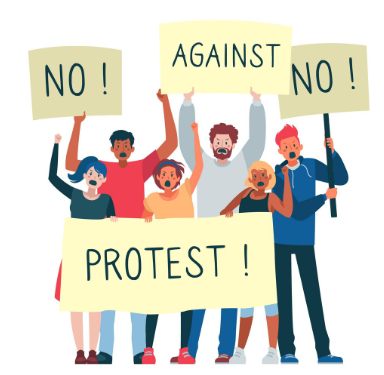
A protest is a public expression of objection, disapproval, or dissent against a policy, action, or idea, often by individuals or groups gathering to make their views known to influence public opinion or government policy. Right to protest refers to the right of the citizens to peacefully assemble and express dissent against the government or public actions. This right enables individuals and groups to collectively express their dissatisfaction and opposition in the matters affecting social, political or economic life. Protests act as a bridge between citizens and the government allowing the citizens to make their voices heard by the government. Through protest it becomes the responsibility of the government to be accountable and answerable to its citizens. There are various examples of protest in India one was the Wrestler’s Protest (2023) led by
the Olympic and the international wrestlers including Vinesh Phogat, Sakshi Malik and Bajrang Punia who led a peaceful protest against the Brij Bhushan Sharan Singh over allegations of sexual harassment. The protest highlighted the importance of peaceful democratic protest and demonstrated how citizens can seek justice and accountability by exercising their constitutional right to protest.
Another example is Sonam Wangchuk’s Ladakh Protest (2024 –2025) in which he led peaceful marches and hunger strikes demanding Statehood for Ladakh and its inclusion under Sixth Schedule of the Constitution. The protest highlighted the importance of peaceful protest in a democratic society and showed the need to balance between the Right to Protest and public order. In the Indian constitution, although it is not expressly mentioned but Article 19 deals with the right to Protest. It provides the constitutional basis for the right by ensuring the freedom of speech and expression under Article 19 (1)(a) and the right to assemble peacefully and without arms under Article 19(1)(b) and to form associations in 19 (1)(c).
Article 19(1)(a): Freedom of speech and expression
Freedom of speech and expression allows the citizens to express their opinions, ideas, criticism against the government and policy. This expression also includes the protest which allows citizens to publicly voice their concern and demand in a collective manner. In Kameshwar Prasad & Others v State of Bihar & Another (1962) the Supreme Court held that peaceful demonstrations form a part of the freedom of speech and expression under Article 19 (1)(a).
Article 19(1)(b): Freedom to assemble peacefully and without arms Citizens have the right to collectively assemble for meetings, demonstration, rallies in order to express their demands and concerns. This right enables citizens to peacefully assemble and ensures that protest remain non-violent and do not threaten the public safety or order. In Himat Lal K. Shah vs Commissioner of Police, Ahmedabad (1973)11 The Supreme Court held that the right to assemble peacefully is a fundamental right under Article 19 of the constitution. The citizens have the right to hold public meetings and procession on street but it should be peaceful and without arms. The State cannot impose a complete ban on such assembly.
Article 19(1)(c): Freedom to form associations, unions or cooperative societies. This right enables the individual to organise collectively for common concerns or issues. It allows citizens to form unions or associations that mobilize public participation and coordinate collectively. Organised associations strengthen the effectiveness of protest by providing leadership and representation. In All India Bank Employees Association v. National Industrial Tribunal (1962)13 The Supreme Court held that the right to form association is a fundamental right, recognising that citizens must be free to organise collectively to protect and advance their interests.
Reasonable restrictions of Right to Protest
Though the Right to Protest is a fundamental right that allows its citizens to express their opinions, ideas, demands freely without any interference but this right is not absolute. It imposes reasonable restrictions ensures imposed by the State on the citizens These restrictions are necessary in order to maintain public order, national security and also the functioning of the society. In the Indian constitution Article 19(2), 19(3) and 19(4) deals with reasonable restrictions. Article 19(2) allows the State to impose reasonable restrictions on the freedom of speech and expression.
14 Restrictions under this article may be imposed on the ground such as sovereignty and integrity of India, security of the State, friendly relations with foreign States, public order, decency or morality, contempt of court, defamation and incitement to an offence. Article 19(3) allows the State to impose the reasonable restrictions on the right to assemble
peacefully and without arms. 15 The grounds for such restrictions are narrow but it includes sovereignty and integrity of India and public order. This ensures peaceful gatherings that do not threaten the safety of citizens. Article 19(4) enables the State to impose reasonable restrictions on the right to form associations or union. 16 Restrictions under this clause are permitted in the interest of sovereignty and integrity of India, public order and morality. This allows the States to regulate the formation of organisation that may otherwise act against national interest or public welfare.
Balancing the Right to Protest with Public Order
The Right to Protest is a fundamental right of the citizens while maintaining public order is a constitutional duty of the State. The Constitution grants citizens the right to express their concerns and form peaceful assemblies while it remains the responsibility of the State to ensure that such protest does not disturb public safety, become violent and infringe the right of the other citizen. There is a need to balance the right to protest with the State’s duty to maintain the public order.
Balancing these two aspects is essential because an imbalance in either direction can have serious consequences. If citizens are given rights without any restrictions, it may lead to violence, property damage, harm to other individual etc. On the other hand, if the State imposes excessive restrictions and denies the rights of the citizens then it will violate Article 19 of the Indian Constitution. Therefore, a careful balance between both the rights as well as a duty is important; it safeguards both individual freedoms and collective security ensuring that protests remain peaceful and within the framework of law.
In Re: Ramlila Maidan v Home Secretary Union of India (2012) In this landmark judgement, the Supreme Court upheld the right to protest as a fundamental right under Article 19. The court declared the Right to Sleep is a part of right to life under Article 21, and the State must maintain a balance between both the public order and the right of the citizens. The court ruled that the police action of using force and lathi charge on sleeping peaceful protesters was illegal and unconstitutional.
In Amit Sahni vs Commissioner of Police (2020) The Supreme Court held that the right to protest is a fundamental right, it cannot be exercised in a manner that blocks public road or causes disruption to public life. Public ways and public spaces cannot be occupied indefinitely for protest.
In Mazdoor Kisan Shakti Sangathan (MKSS) v. Union of India (2018) The Supreme Court held that right to protest is a fundamental right and examined the balance between the citizens right to peaceful assembly and the State’s duty to maintain public order.
In XYZ & Ors. v. State NCT of Delhi and Ors. (2023) The Supreme Court treated the allegations of protesting women wrestlers as serious and entertained the petition under Article 32. The court ensured the grievances should be address by registration of FIR’s and provided security to the complainants thereby reaffirmed that citizens can seek judicial protection when peacefully protesting.
Recent Judicial Developments
In Danaram Choudhary v. State of Rajasthan (2025) The Rajasthan High Court quashed the FIR against the protesters and held that peaceful protest is a constitutional right, merely gathering on the public road, raising slogans against government decision does not make the protest unlawful. Citizens have the right to question the action of the
authorities when their actions are directly affecting their rights or livelihood. In Krishnamoorthy vs The State and Another23 (2026) the Madras High Court quashed the criminal proceedings and held merely raising slogans against the government or a peaceful protest does not amount to a criminal offence. The Court observed “showing protest is the hallmark of democracy” and a fundamental right guaranteed by the Constitution”.
Conclusion
The Right to Protest is one of the most important right of the individuals in the democratic society. Article 19 of the Indian constitution provides this right through freedom of speech and expression, the right to assemble peacefully and form association. These rights help citizens to question the authority and protect their interest. However, the rights are not absolute; it imposes reasonable restrictions on the citizens to protect and secure the society. While the State can
impose restrictions but the State cannot impose absolute ban or violate the rights of citizens. Hence there is a need to balance both duties of the State and rights of citizens to strengthen the Constitution.
About the Author